Why does the Eiffel Tower grow in summer?
Short answer: The Eiffel Tower grows in summer because its iron expands when it warms up. Puddled iron gets longer by about 12 millionths of its length for every degree Celsius, and over 300 meters of tower that adds up. Measured from cold winter days to the hottest summer days, the tower is 12 to 15 centimeters taller.
A tower of 18,038 iron pieces
Gustave Eiffel's company built the tower from 1887 to 1889 for the 1889 World's Fair in Paris. The design is credited to two of the company's senior engineers, Maurice Koechlin and Émile Nouguier. They proposed the name "Tour de 300 mètres," a hint at the height record they were after.
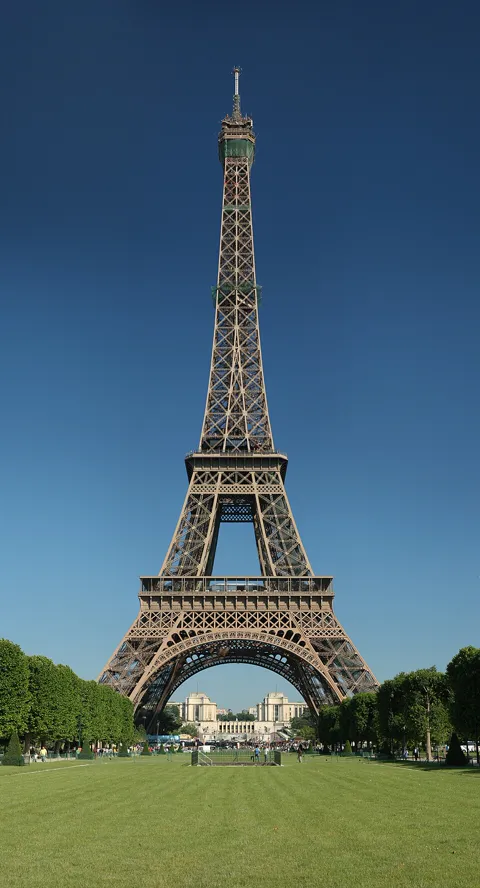
The structure is puddled iron, a form of wrought iron that Eiffel knew well from earlier projects. Workers joined 18,038 separate parts with 2.5 million rivets. The ironwork weighs 7,300 tonnes. Lifts, shops and antennas bring the total to about 10,100 tonnes. The base is a square 125 meters on each side.
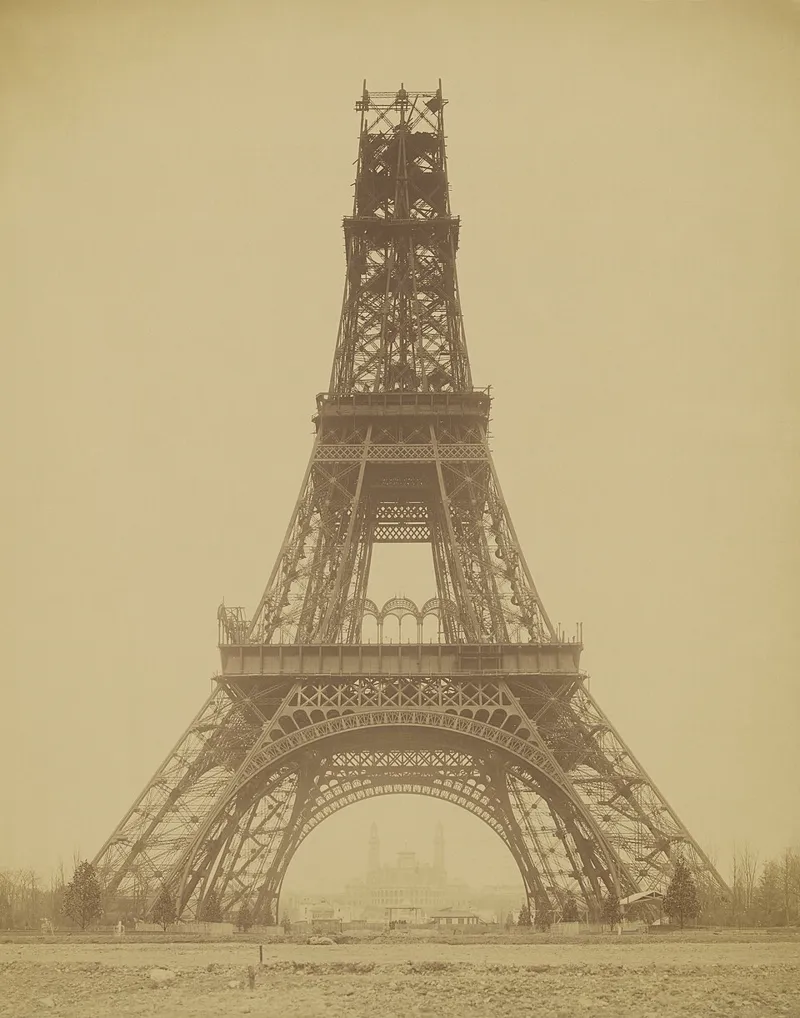
That much iron needs looking after. The tower gets 60 tons of paint every 7 years to keep it from rusting.
What heat does to iron
Most solids get longer when they warm up and shorter when they cool down. How much depends on the material. Engineers describe it with the coefficient of thermal expansion: the fraction of its length a piece grows for each degree Celsius.
Ceramics barely move, at 0.5 to 1.5 millionths per degree. Metals sit between 5 and 30 millionths, and polymers between 50 and 300. The puddled iron and steel of the Eiffel Tower come in at about 12 millionths per degree.
In practice, a one-meter iron bar grows by 12 microns when it warms by one degree. That is 0.012 millimeters, thinner than a human hair. Nobody would notice it on a fence post. The Eiffel Tower is 300 meters of iron stacked upward.
From microns to centimeters
Two things turn a hair's width into something you can measure with a tape: length and the temperature range.
Paris has kept temperature records for more than two centuries. Winter lows have dropped below −20 °C, and summer highs reach about 40 °C. Iron in direct sun gets hotter than the air around it, often above 60 °C or 70 °C.
The arithmetic is short: a 100-meter iron bar that warms by 100 degrees grows by 0.12 meters. A 300-meter bar grows three times as much: 36 centimeters.
The real tower grows less than that. A simple bar does not behave like a tower made of more than 18,000 riveted pieces pointing in every direction. Federico de Isidro Gordejuela, an architect and professor at Universidad CEU San Pablo, writes in The Conversation that specialists put the real growth at 12 to 15 centimeters between cold winter days and the hottest days of summer. That is about 5 to 6 inches. When the cold returns, the iron contracts and the tower comes back down.
Why the tower leans away from the sun
The sun never heats all four sides at once. The face in direct light warms more than the faces in shade, so it grows more than the others. The result is a slight curve, as if the tower were leaning away from the sun.
Depending on the air temperature, the top can shift up to 18 centimeters away from the sun, because the metal on the sunny side expands more. After dark the lean evens out again.
Wind moves the tower too, though by less: it sways by up to 9 centimeters. Eiffel picked puddled iron partly because it allowed a large, light tower that stays safe against horizontal wind forces.
Bridges and rails do it too
Long metal structures do the same. The Garabit Viaduct in France is 565 meters long, and the Forth Bridge in Scotland is over 2.5 kilometers long. Both grow when their metal warms up. The longer the structure, the larger the movement, which is why heat also affects the railway tracks that many bridges carry.
Bridges move in more complicated ways. The Eiffel Tower, by comparison, mostly grows and shrinks vertically, with the sunny-day lean on top of that.
Centimeters from heat, meters from antennas
The tower's official height has changed more than its iron ever will. It opened at 300 meters, plus a flagpole. A television antenna added 18.7 meters in 1957. Work in 2000 brought the total to 324 meters. A digital radio antenna hoisted on March 15, 2022 took the tip to 330 meters.
Heat adds only centimeters to those numbers, and it gives them back every winter. In de Isidro Gordejuela's words, the Eiffel Tower is also, in effect, a giant thermometer. Its height on any given day says something about the weather in Paris.
FAQ
How much taller does the Eiffel Tower get in summer?
About 12 to 15 centimeters, or 5 to 6 inches, comparing the hottest summer days with cold winter days. A simple 300-meter iron bar would grow 36 cm over a 100-degree swing, but the riveted tower grows less.
Is the Eiffel Tower made of iron or steel?
Mostly puddled iron, a form of wrought iron, with some steel components. Both expand by about 12 millionths of their length per degree Celsius.
How heavy is the Eiffel Tower for its size?
Its ironwork weighs 7,300 tonnes, close to the weight of the air inside its outline, about 6,300 tonnes. Melted down, the metal would cover its 125-meter square base only about 6 cm deep.
Does the Eiffel Tower move in the wind?
A little. It sways by up to 9 centimeters in the wind. The sun moves the top more: up to 18 centimeters away from the sunny side.
How tall is the Eiffel Tower?
330 meters to the tip of the antenna since March 2022. The iron tower itself was built as a 300-meter structure for the 1889 World's Fair.