Why do jeans have a tiny pocket?
Short answer: The tiny pocket on your jeans is a watch pocket. Levi Strauss & Co. and Jacob Davis put it on the riveted work pants they patented in 1873, when men carried pocket watches instead of wristwatches. Pocket watches gave way to wristwatches in the 20th century, but the small pocket stayed, and Levi's still calls it the watch pocket.
Work pants with metal in the corners
On May 20, 1873, Levi Strauss & Co. and Jacob Davis received U.S. Patent No. 139,121 for an "Improvement in Fastening Pocket-Openings." The patent covered copper rivets at the pocket corners, where heavy use tore the fabric. The rivets kept the pockets from ripping and made the openings stronger.
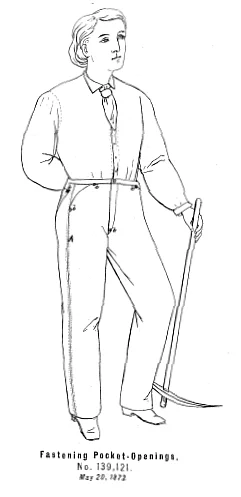
The company sold these pants as "waist overalls," work clothes meant for hard use. In 2022 a pair from the 1880s, found in an abandoned mine shaft, sold at auction in New Mexico for $87,400.
Where the tiny pocket sits
The original pants had four pockets, all riveted. Three sat on the front, including a small one above the larger right pocket. The fourth was a single back pocket on the right side, under the leather patch. The back left pocket only arrived in 1901.
Made for a watch
Levi Strauss & Co. calls the small pocket on the right front side the watch pocket. It was "intended to store a pocket watch," a typical possession in the late 1800s.
Wristwatches existed, but early on women wore them almost exclusively. Men used pocket watches until the early 20th century. A worker in riveted pants checked the time on a watch from his pocket. The jeans gave that watch a pocket of its own.
How the 501 got its number
In 1890 the rivet patent entered the public domain. The same year, Levi Strauss & Co. began giving its products lot numbers, and "501" went to the copper-riveted waist overalls. Nobody knows why the company picked that number. The company lost its records in the 1906 San Francisco earthquake.
The back left pocket followed in 1901. Then, in 1937, after customer feedback, Levi's began covering the rivets on the back pockets with fabric. By 1966 those back rivets were gone altogether. The watch pocket rivets stayed, apart from a few years during World War II.
The war took the rivets but not the pocket
During World War II, the U.S. War Production Board classed Levi's jeans as staple work clothing. Wartime rules controlled how they were made, to save material. Levi's took the rivets off the watch pocket and dropped the crotch rivet.
The curved Arcuate stitching on the back pockets went too, because the thread counted as decoration. Levi's painted the design on each pair instead, with a pocket label promising it would only be painted "for the duration." Branded buttons gave way to standard-issue ones with a laurel leaf design. Some pairs got pocket bags cut from military green fabric instead of white.
Through all of it, the watch pocket stayed on the 501, only without its rivets. In 1947 the post-war 501 jeans came off the line with rivets back on the watch pocket. The crotch rivet never returned.
Why it is still there
Pocket watches gave way to wristwatches in the 20th century, and the small pocket lost its first job. Levi's kept it on the 501 anyway and still calls it the watch pocket.
You may have heard it called the "fifth pocket." Levi's says that name belongs to the back left pocket, the one added in 1901. By that count, the watch pocket is one of the original four.
Many people keep coins or keys in it today. Check the pair you are wearing: if there is a tiny pocket above the right front one, it is the watch pocket from the 1873 design.
FAQ
Is the small pocket on jeans for coins?
Many people use it for coins, but Levi Strauss & Co. says the small pocket on the right front side was meant to hold a pocket watch, a typical possession in the late 1800s. That is why the company calls it the watch pocket.
Is the watch pocket the "fifth pocket"?
People often call it that, but Levi's gives the name to the back left pocket, which the company added in 1901. The watch pocket was one of the four pockets on the original riveted pants.
When did Levi's jeans get the number 501?
In 1890, the year the rivet patent entered the public domain. That year Levi Strauss & Co. began using lot numbers, and 501 went to the copper-riveted waist overalls. The company lost its records in the 1906 San Francisco earthquake, so nobody knows why it chose that number.
Why did Levi's remove the rivets during World War II?
Under War Production Board rules, Levi's jeans counted as staple work clothing, and wartime controls on how they were made aimed to save material. Levi's took the rivets off the watch pocket and dropped the crotch rivet. The watch pocket rivets came back on the post-war 501 jeans in 1947.