Why are airplane windows round?
Short answer: Airplane windows are round because a pressurized cabin swells and shrinks on every flight, and a sharp corner collects that stress in one small spot. Metal fatigue cracks start there. Engineers learned this from the de Havilland Comet, the first jet airliner, after two Comets broke apart in the air in 1954.
The first jet airliner
On May 2, 1952, BOAC put the de Havilland Comet into service. It was the world's first commercial jet airliner. The prototype first flew from Hatfield on July 27, 1949. The design brief asked for a cruise of about 400 mph at around 40,000 feet.
Flying that high meant pumping the cabin full of air so passengers could breathe. The Comet's high cabin pressure and operating speeds had no precedent in commercial aviation.
A cabin that breathes in and out
The fuselage works like a long aluminum balloon. On the ground, the air pressure inside and outside is the same. As the plane climbs, the outside air thins while the cabin keeps its pressure. The skin bulges outward by a tiny amount. On the way down, it shrinks back.
A single cycle does no harm. Thousands of them can. Metal that flexes the same way again and again cracks at loads far below what would break it in one go. Engineers call this metal fatigue. In the early 1950s, engineers did not yet fully understand it.
Two Comets break up over the Mediterranean
On January 10, 1954, BOAC Flight 781 left Rome's Ciampino airport on the last leg of a trip from Singapore to London. Over the sea near the island of Elba, the aircraft, registration G-ALYP, broke apart. All 35 people on board died.
BOAC pulled its Comets out of service, and investigators first looked at bombs and engine explosions. The airline put the jets back in the air on March 23, ten weeks after the crash. On April 8, 1954, South African Airways Flight 201, another Comet, took off from the same Rome airport heading for Cairo. It went down near Naples. All 21 on board were killed, and the Comets were grounded again.
A whole airliner in a water tank
Sir Arnold Hall, head of the Royal Aircraft Establishment at Farnborough, led the investigation. His team built a tank around a complete Comet, G-ALYU, and filled its cabin with water instead of air. Then they pumped the cabin up and let it down again, around the clock.
After the equivalent of about 3,000 flights, the fuselage split open. The tear began at a corner of a cut-out. Wreckage pulled from the sea near Elba told the same story. G-ALYP's cabin had failed at the corner of one of two ADF windows in the roof. These were openings for the antennas of a radio navigation system, covered with fiberglass panels instead of glass. The official report came out on February 1, 1955.
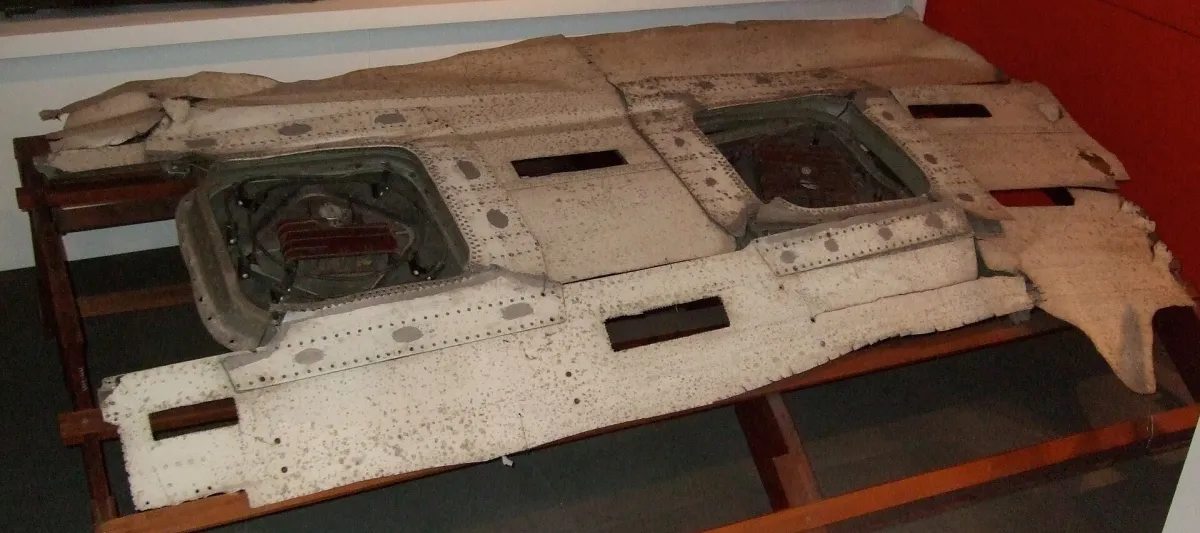
Why a corner is the weak spot
Stress in the cabin skin behaves a bit like water in a stream. Put a rock in the way and the flow has to go around it. A smooth, rounded rock lets the water curve past. A rock with sharp edges forces it through a tight turn, and the pressure peaks there.
Metal works the same way. Even a round hole raises the stress. In a flat plate under tension, the edge of a circular hole carries three times the average load. The peak sits where the edge curves most tightly. A sharp corner has almost no radius, so the load from the whole panel crowds into a tiny area. A crack starts there, and each new pressure cycle makes it longer.
The Comet's own windows
A popular version of this story says the Comet had square passenger windows. It didn't. The Comet 1's cabin windows were rectangles with rounded corners, and the accident report did not name their shape as a cause. The fatal crack started at the near-square roof cut-out for the antenna.
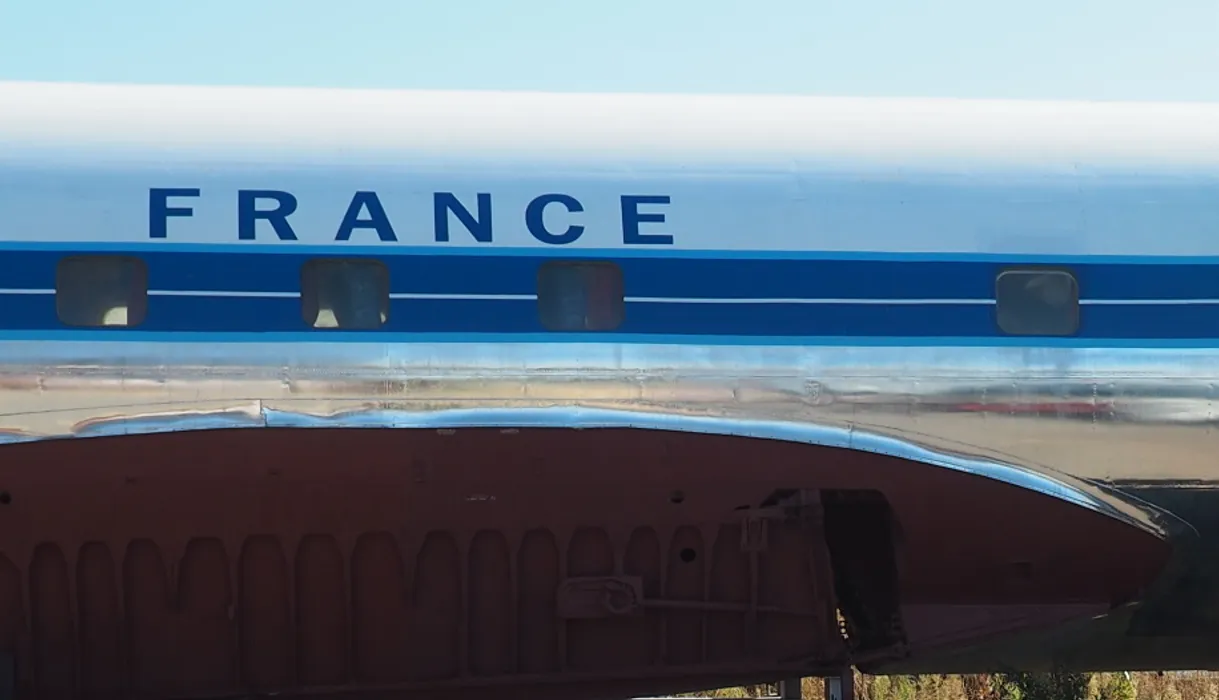
Why rounded windows became the rule
Round and oval windows were not a jet-age invention. The Douglas DC-4, some Lockheed Constellations and the Boeing 377 Stratocruiser had them before the Comet flew. Piston airliners such as the Douglas DC-6 had rectangular windows with small rounded corners, much like the Comet 1. They cruised lower, so their cabins held a smaller pressure difference, and their windows did not crack.
After the crashes, de Havilland rebuilt the design with thicker skin and rounded openings. The Comet 2 and Comet 3 got oval passenger windows, and surviving Comet 1As were refitted with them. Later jets such as the Boeing 707 and Douglas DC-8 went back to rectangles, with a larger corner radius than early designs. That curve keeps the stress spread out while you still get a wide view.
The window next to your seat follows the same rule. Its corners are curves, sized for the pressure your cabin holds at cruising height.
FAQ
Which Comet crashes were caused by metal fatigue?
Two. BOAC Flight 781 broke up near Elba on January 10, 1954, with 35 people on board, and South African Airways Flight 201 went down near Naples on April 8, 1954, with 21. A third Comet, BOAC Flight 783, crashed in a severe thunderstorm after takeoff from Calcutta on May 2, 1953; that loss came from overstressing in bad weather.
Did older airliners have square windows?
Not all of them. The Douglas DC-4, some Lockheed Constellations and the Boeing 377 Stratocruiser already had round or oval windows. Piston airliners such as the Douglas DC-6 used rectangles with small rounded corners, and they cruised low enough that the smaller cabin pressure difference did not crack them.
Are airplane windows completely round today?
Most are rectangles with well-rounded corners. The Boeing 707 and Douglas DC-8 set that pattern with a larger corner radius than early designs, which keeps stress spread out and still gives a wide view.
How much does a hole raise the stress in metal?
In a flat plate pulled in one direction, the edge of a circular hole carries three times the average stress. The tighter the curve at the edge, the higher the peak, so a sharp corner is worse than any circle.