Why do we carve pumpkins on Halloween?
Short answer: We carve pumpkins because Irish and Scottish immigrants brought a turnip-carving custom to America and found pumpkins easier to carve. On Samhain night, when the dead were thought to walk among the living, people carved faces into hollow turnips and lit them with an ember. Folklore tied the lanterns to Stingy Jack, who wanders with a coal in a turnip.
Samhain: the night the dead came close
Halloween grew out of Samhain, a Gaelic festival. It marked the end of the harvest and the start of winter, the "darker half" of the year. In Ireland and Scotland it was a time when supernatural beings, the Aos Sí, were said to walk the earth. On Samhain eve, 31 October, "spirits of the dead were thought to mingle with the living," National Geographic writes.
To ward off those restless souls, people dressed up in costumes. They also made lights with faces.
Lanterns made from turnips
The first jack-o'-lanterns were root vegetables. Turnips were common, along with rutabagas, beets, potatoes and mangelwurzels (a kind of beet). All of them were usually plentiful after the harvest. Metal lanterns were expensive, Nathan Mannion of EPIC The Irish Emigration Museum told National Geographic. So people hollowed out a vegetable and put an ember inside.
In the 19th century this was part of Halloween in parts of Ireland, Scotland, Wales and England. The lanterns were "turnips or mangel wurzels, hollowed out to act as lanterns and often carved with grotesque faces." In Worcestershire, a carved turnip called a "Hoberdy's Lantern" is recorded as early as the end of the 18th century.
People who made the lanterns gave different reasons for the faces. Some said the lanterns stood for spirits or other supernatural beings. Others used them to keep evil spirits away. A lantern on a windowsill was meant to keep harmful spirits out of the home.
People out in costume sometimes carried them to frighten others. Another theory ties them to All Saints' Day on 1 November, whose eve is Halloween. In that reading, the lights stood for Christian souls in purgatory.
Stingy Jack, the man who tricked the devil
An 18th-century Irish folktale gave the lantern its hero, Stingy Jack. He is often said to be a blacksmith with a taste for drink and mischief. The details change from one telling to the next. In most of them, Jack tricks the devil twice.
In one trick, Jack talks the devil into turning himself into a coin to pay for their drinks. Jack slips the coin into his pocket next to a small silver cross, and the devil is stuck. In another, Jack sends the devil up an apple tree. Then he carves a cross into the trunk, so the devil cannot climb down. Each time Jack lets him go only after a promise: the devil will leave him alone and will never take his soul.
When Jack dies, heaven will not have him. Hell cannot take him either, because of the promise. The devil gives him a burning coal to light his way, and Jack puts it inside a hollowed-out turnip. He has wandered the earth with it ever since, as "Jack of the Lantern."
Where the name jack-o'-lantern comes from
The word is older than the link to the story. The Oxford English Dictionary records "jack-o'-lantern" in Britain from 1658. Then it meant the will-o'-the-wisp, the strange lights that flicker over peat bogs. From 1663 it could also mean a man with a lantern, such as a night watchman. The first known use for a lantern carved from a turnip or pumpkin dates from 1837.
Even the link to Stingy Jack is only a suggestion. The Irish origin of the custom is widely accepted, but no scholarly research has proved it.
Why America switched to pumpkins
In the 19th and early 20th centuries, Irish and Scottish immigrants brought the custom across the Atlantic. In North America they found the pumpkin. It was common there and much better suited to carving than a turnip or a potato.
At first the carved pumpkin belonged to the harvest season in general. John Greenleaf Whittier's poem "The Pumpkin" (1850) remembers carving "wild, ugly faces" with "a candle within." It mentions Thanksgiving and says nothing about Halloween. On 1 November 1866, a newspaper in Kingston, Ontario, reported "a great sacrifice of pumpkins" to make faces lit by candles.
In 1885, an article in Harper's Young People said that "American boys delight in the funny grinning jack-o'-lanterns made of huge yellow pumpkins with a candle inside." In 1892 the Atlanta Constitution praised a Halloween party at the mayor's home for its "smiling lanterns made of pumpkins, cleverly carved with faces."
The pumpkin also reached Halloween through stories. Washington Irving's "The Legend of Sleepy Hollow" came out in 1820. The story itself does not mention jack-o'-lanterns, but later versions often show the Headless Horseman with one in place of his head.
The turnip lantern in an Irish museum
The National Museum of Ireland, Country Life, in County Mayo still shows what the old lanterns looked like. According to IrishCentral, a turnip lantern carved in 1903 at Baile na Finne, County Donegal, survives there. The museum's permanent exhibition also has a "ghost turnip." It is a plaster cast of an early-1900s turnip lantern, "complete with craggy teeth and sinister eye slits."
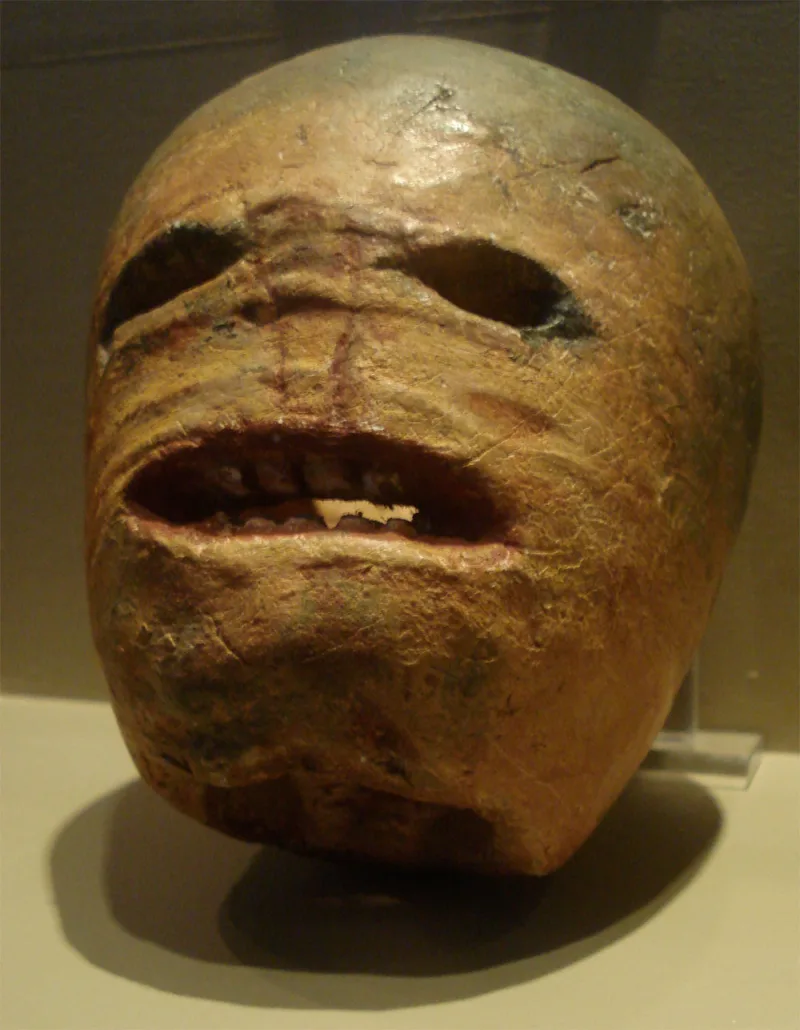
IrishCentral calls the turnip originals "far more frightening" than pumpkins, and the cast shows why. The ghost turnip is on permanent display near Castlebar, County Mayo. It shows Halloween's face before America gave it a pumpkin.
FAQ
What were jack-o'-lanterns made of before pumpkins?
Root vegetables: turnips, but also rutabagas, mangelwurzels, beets and potatoes. They were hollowed out, carved with faces and lit with an ember or a coal.
Why did people carve faces into turnips?
On Samhain, 31 October, the dead were thought to mingle with the living. The lanterns were said to stand for spirits or to keep evil spirits away, and some were set on windowsills to keep harmful spirits out of the home.
Who was Stingy Jack?
The hero of an 18th-century Irish folktale. He tricked the devil twice, was refused by heaven and hell after he died, and wanders the earth with a burning coal inside a carved turnip.
Why did Americans switch to pumpkins?
Irish and Scottish immigrants found pumpkins common in North America, and pumpkins were much better suited to carving than turnips or potatoes.
What does a jack-o'-lantern symbolize?
Its makers gave different answers: a spirit or supernatural being, a guard against evil spirits, or, in one theory, a Christian soul in purgatory. In the Stingy Jack folktale it is the light of a soul barred from heaven and hell.
Where can you see an old turnip lantern?
At the National Museum of Ireland, Country Life, in County Mayo. IrishCentral reports that a turnip lantern carved in Donegal in 1903 survives there, and the museum shows a plaster cast of an early-1900s "ghost turnip."