Why do pen caps have a hole?
Short answer: Pen caps have a hole so that a cap stuck in the windpipe does not block it completely. The safety standard ISO 11540 requires such a vent on pens that children up to 14 are likely to use. The vent must pass at least 8 liters of air a minute. Fountain pens made for adults are exempt.
A cap that lets you breathe
Pen caps are small and smooth, and they end up in mouths. Gear Patrol calls pen cap inhalation a common problem in school-aged children. A cap with a closed end would work like a stopper in the windpipe. Air could not get past it.
The hole changes that. BIC says the hole is there "to prevent the cap from completely obstructing the airway if accidentally inhaled." A patent from Pilot Ink, a Japanese company in the Pilot pen group, explains how. The inside of the cap is open to the air at both ends. So even when a cap is stuck in a child's windpipe, the child "can still inhale and exhale through the cap."
ISO 11540: the rule behind the pen cap hole
The hole is required by a safety standard. In Britain, British Standard 7272 of 1990 set a test for pen caps. In 1993 the International Organization for Standardization published ISO 11540, with design rules for the caps of writing and marking instruments.
The standard covers pens that children up to 14 are likely to use. If such a pen has a cap, the cap must reduce the risk of suffocation when swallowed. According to Mental Floss, the vent must let through at least 8 liters of air a minute, about 2 gallons.
Pilot's patent cites the British test. The cap must pass that flow with a pressure difference of no more than 1.33 kPa. That keeps the air moving without a hard pull from the lungs. The patent's own cap meets it with two round openings, each 3 mm across.
The hole in the BIC Cristal cap
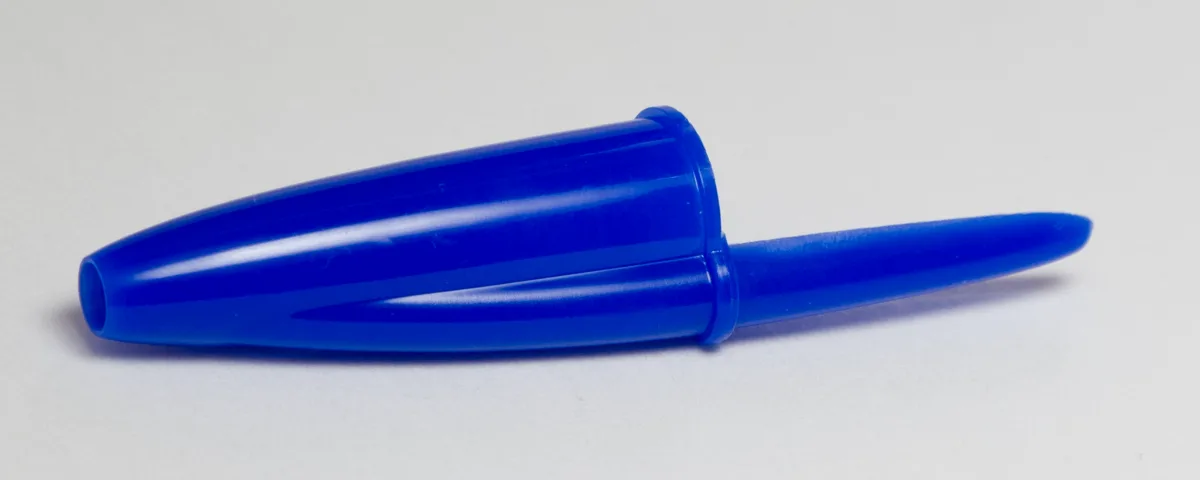
On the BIC Cristal the vent sits right in the tip of the cap. According to BIC's website, quoted by ScienceAlert, all its caps meet the international safety standards on inhaled caps. The Cristal meets them with a small hole in its top.
Gear Patrol cites the book Iconic Designs: 50 Stories about 50 Things, which says BIC has made vented caps since 1991.
Did the vented cap work?
Before the rule, pen caps killed children. Mental Floss reports that nine children in the UK died after swallowing pen caps between 1970 and 1984. After the UK adopted the standard, deaths "dropped precipitously."
Mental Floss describes a study from Beijing of 34 children who had inhaled pen caps. None of them died, and doctors removed every cap.
What happens if a child inhales a pen cap
A vented cap is still an emergency. The hole only buys time until a doctor can remove the cap, Gear Patrol notes. Taking it out is hard, too. Mental Floss points out that a smooth plastic cap is difficult for doctors to grip in a throat.
The vent can also fail. Gear Patrol reports that one UK teenager died when the vent in the cap he had inhaled became clogged. Mental Floss mentions a 13-year-old in the UK who died in 2007 after swallowing a pen cap.
The pens that don't need one
The rule is about children, so it has limits. Pens clearly designed for adults, like fancy fountain pens, don't need a hole, Mental Floss writes. Neither do caps too big to swallow. BIC names the same exception: caps "considered too large to be a choking hazard."
So a fountain pen made for adults can have a smooth, closed cap. The cheap pen in a school pencil case has a hole.
Does the hole help the pen itself?
The vent helps when you put the cap back on. A closed cap traps a pocket of air that pushes back as you press it down. With a hole, that air escapes. Gear Patrol says the hole makes pen lids easier to put on and take off. ScienceAlert says it lets the lid close properly.
BIC adds that its caps also help keep a pen from leaking. Pick up the nearest cheap ballpoint and look at the tip of its cap. If it was made with a pencil case in mind, the hole will be there.
FAQ
Why is there a hole in a pen cap?
So that a cap inhaled by accident does not completely block the airway. If it lodges in the windpipe, air can still pass through the hole and the hollow cap.
Which rule requires the hole, and how much air must pass?
ISO 11540, published in 1993, and the earlier British Standard 7272 of 1990. They cover pens likely to be used by children up to 14, and the cap must let through at least 8 liters of air a minute.
Does the hole make swallowing a pen cap safe?
No. It only buys time until a doctor can remove the cap, and the vent itself can clog.
Why do fountain pens not have a hole in the cap?
Pens clearly designed for adults, and caps too large to swallow, are exempt from the rule.
What should you do if a child inhales a pen cap?
Get medical help at once. The vent only buys time, and it can clog. In a Beijing study of 34 children who inhaled pen caps, doctors removed every cap and none of the children died.
Sources
- Mental Floss: The surprising reason why pen caps have tiny holes in the top (Shaunacy Ferro, May 2018)
- Gear Patrol: Your pen has a secret feature that can save your kid's life (Tyler Chin, April 2024)
- IFLScience: There's a surprising reason why pen caps have holes in them (Robin Andrews, May 2018)
- ScienceAlert: There's a reason for holes on the tops of pen caps (Fiona MacDonald, May 2016)
- Pilot Ink: US patent 5127754, Writing instrument's cap with safety vent (1992)